The Curse of a "Normal" Business: Why an Investor Would Rather Lose Money on You Than Get a 2x Return
- IBDA GLOBAL

- Mar 16
- 3 min read

Imagine the situation: you come to an investor and say: "We have a great business. We’ve been profitable since day one. We are growing at 20% a year, and there are almost no risks. Your money is safe." Do you expect him to be happy?
In reality, at that moment, he is mentally crossing you off his list.
It sounds paradoxical, but in the venture world, a "good, stable business" is a diagnosis. Founders often confuse a classic business (SME — Small and Medium Enterprise) with a startup. These are different sports. If a bank looks for reliability, a venture fund looks for an anomaly. Let's break down why your stability is the enemy of his portfolio.
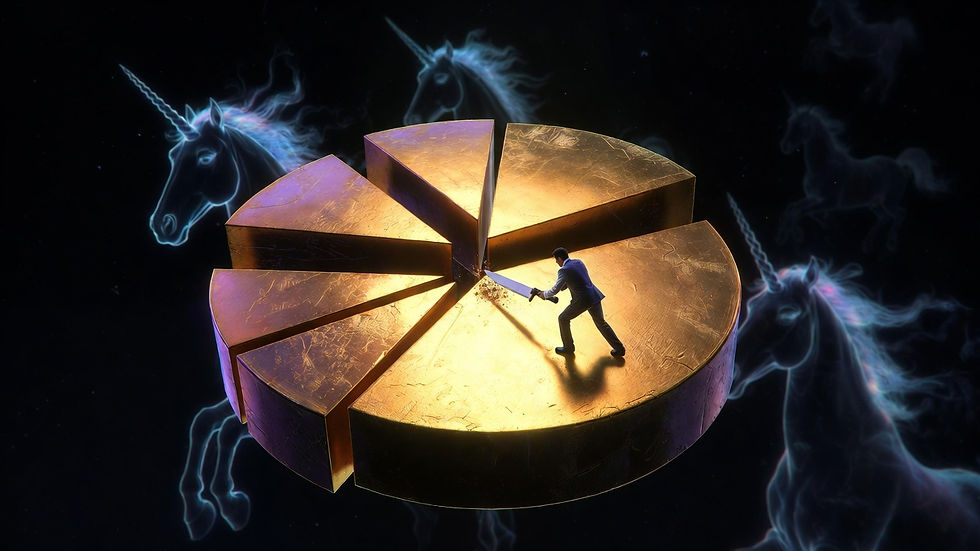
The Brutal Math of the Power Law The venture model doesn't work the way you think. A fund doesn't earn a little bit from every company. The statistics are relentless: out of 10 invested startups:
5 will die (the investor loses 100% of the money).
3 will become "zombies" (return the investment or give a small profit).
Only 1 or 2 will become "stars" that grow 100x.
The entire economics of the fund relies on a single winner. This lone "unicorn" must cover not only its own investment but also the losses of all nine failures, plus generate a profit for the fund's backers (LPs). Therefore, an investor is not looking for someone who will return $2 for every $1 invested. He is looking for someone who will return $100 or die trying.
The Zone of the Living Dead A venture investor's worst nightmare is a "zombie" company (The Living Dead). This is a business that isn't bad enough to die, but isn't good enough to make an Exit (an IPO or a sale to a strategic buyer).
Such a company can generate a small profit for years, feed the founders, and pay salaries. For you, this is success. For the investor, this is "frozen capital." His money is stuck in an asset that cannot be sold with a multiplier. He cannot take it back, and he receives no outsized return.
The "Venturability" Test Before going for money, ask yourself an honest question: "Is my market and my business model capable of delivering 10x growth in 5 years?"
If you are opening a coffee shop chain, a design studio, or a consulting agency—it is a wonderful business. You will be rich and happy. But you are not a startup. You need loans, grants, or private interest-bearing loans, but not venture money.
By taking venture money for a "normal" business, you are signing a contract with the devil. The investor will force you to reinvest all profits into aggressive growth, to take risks, and to burn money for the sake of capturing market share. He will break your cozy model for the ghost of a chance at a billion-dollar valuation.
Conclusion Do not seek venture investment if you want a quiet life and dividends. Venture is a game of "all-in."
An investor doesn't need "a bird in the hand." He needs the hawk in the sky, even if he has to burn down the forest to catch it. If you aren't ready to set the fire—don't take the matches.